A stateful inventory automation designed to identify low-stock items and update selected product variants without manually reviewing and editing every record.
Businesses that manage multiple products and variants may need to repeatedly check stock levels, identify items running low, prepare warning messages, and update inventory records after restocking.
I built a portfolio-based inventory system that connects these steps into two related workflows: low-stock monitoring and selective inventory restocking.
Operational problem
Repeated stock checking
Low-stock variants hidden inside larger records
Manual warning preparation
Manual record updates after restocking
Risk of updating the wrong product variant
System built
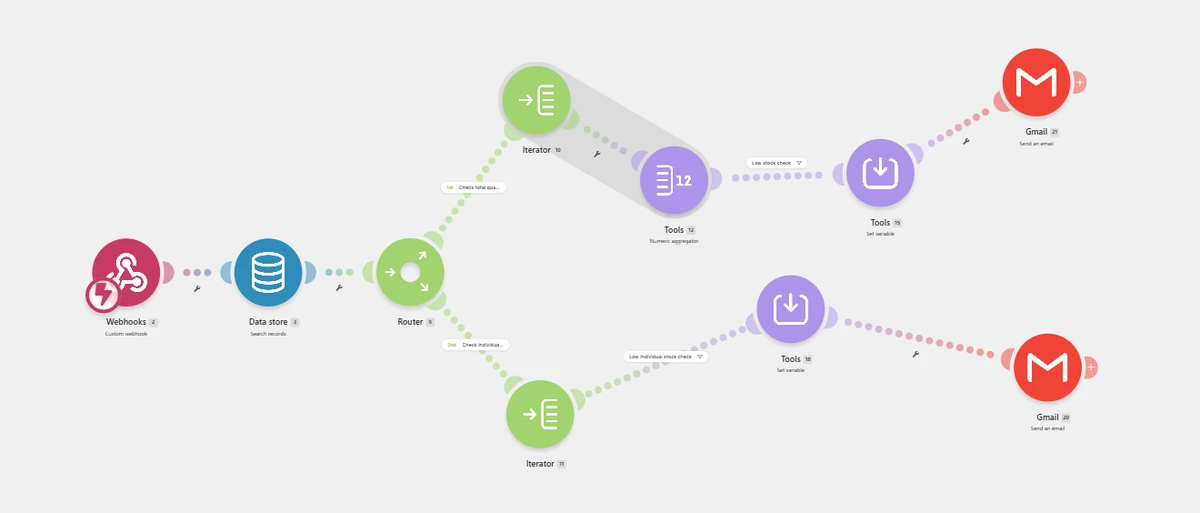
The system uses a persistent Data Store to maintain inventory information between workflow executions. It searches records, filters items based on stock conditions, groups relevant results into one warning, receives restock instructions through a webhook, and updates only the selected product variants.
Workflow diagram
01Inventory Records
02Search Records
03Check Stock Levels
04Identify Low-Stock Variants
05Group Results
06Send Warning
07Restock Webhook
08Match Selected Variants
09Update Matching Records
Tools and technical capabilities
Webhooks
Persistent Data Store
Searching and filtering
Iterator
Array Aggregator
Selective variant updates
Low-stock notification
Inventory record updates
Actual project evidence
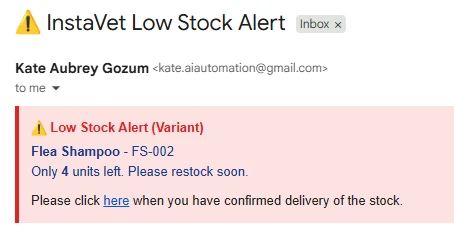
Inventory Data StoreShows structured inventory records with product variants.Stock Monitoring ScenarioShows webhook, Data Store, router, iterators, aggregation, and email modules.Low-Stock NotificationShows the warning email for a low-stock product variant.
Scope note
This portfolio prototype demonstrates the workflow logic. A production version would require real inventory rules, access permissions, audit logging, and backup handling.
Key learning or next improvement
The key learning is that reliable inventory automation depends on matching the correct selected records, not simply updating every item that appears in a request.
Have a similar workflow bottleneck?
I can help map the repetitive steps and identify where practical automation could make the process easier.